Bolt Carrier Group Guide: BCG Coatings and Styles for the AR-15, 300 Blackout, AR-10, AR9 and AR22
Posted by Myth Industries on Nov 20th 2026
The bolt carrier group is the engine of your rifle. Every shot, the BCG unlocks, pulls the spent case, strips a fresh round and locks back up. If the BCG is wrong for the build, nothing else on the rifle will fix it.
This guide covers the two choices every buyer faces: the coating and the style. Then we walk through the right bolt carrier group for each platform: the AR-15 (including 300 Blackout), the AR-10, the AR9 and the AR22. Along the way we answer the BCG questions builders search for most.
What Is a Bolt Carrier Group?
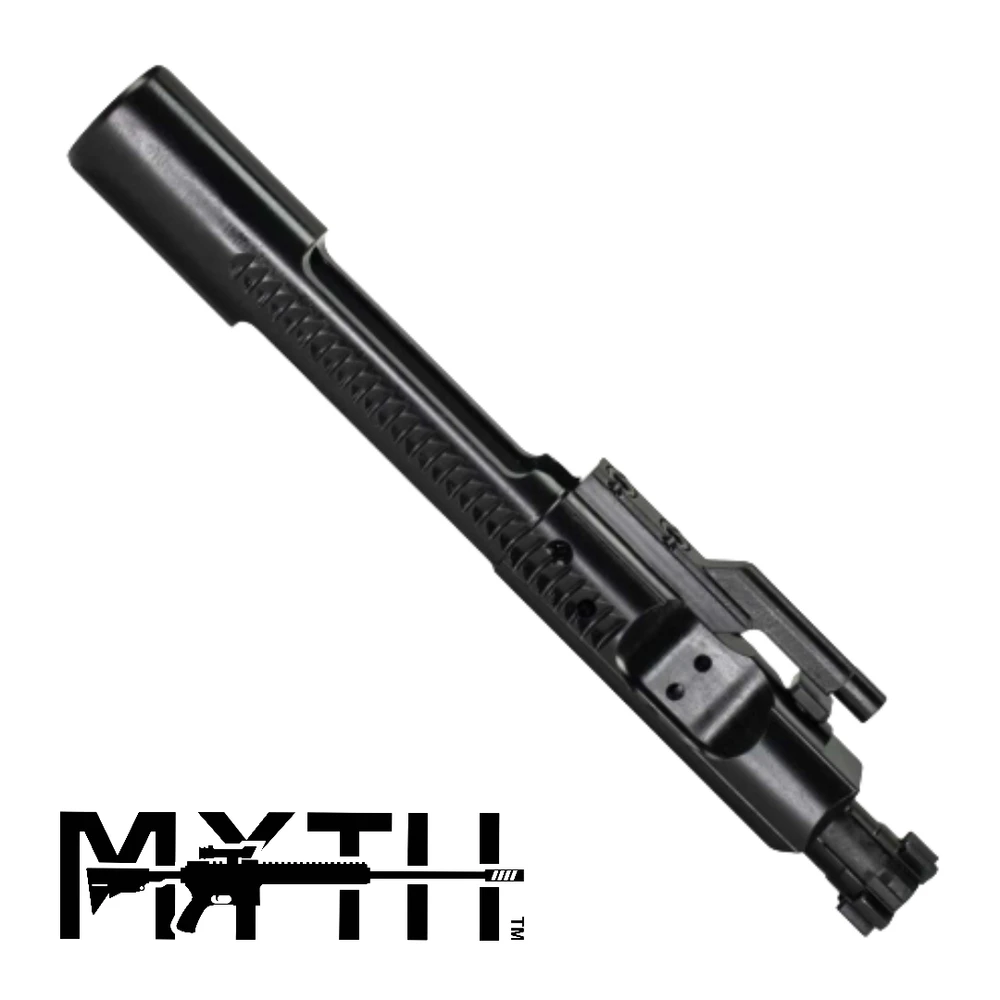
A bolt carrier group, or BCG, is the moving assembly inside the upper receiver. On an AR-15 or AR-10 it has five main parts:
- Carrier: The steel body that rides back and forth in the upper.
- Bolt: The locking piece with lugs that lock into the barrel extension. It holds the extractor and ejector.
- Gas key: The tube on top of the carrier that catches gas from the gas tube.
- Cam pin: Turns the bolt to lock and unlock.
- Firing pin and retaining pin: The firing pin strikes the primer. The retaining pin holds it in place.
The AR9 and AR22 use a different design. They run on blowback, so their bolts work very differently. We cover those below.
BCG Coatings Compared
Coating is the first thing most buyers notice. It affects how slick the BCG feels, how easy it is to clean, how well it resists rust, and the price. Here is how the common finishes stack up.
| Coating | What it is | Strengths | Trade-offs | Best for |
|---|---|---|---|---|
| Manganese phosphate (parkerized) | Matte black conversion coating, the military standard | Proven, holds oil well, low cost, doesn’t change part size | Collects carbon, hardest to clean, needs the most lube | Mil-spec clone builds, duty rifles |
| Black nitride (QPQ / Melonite / salt bath) | A treatment that hardens the steel surface itself | Much harder and slicker than phosphate, cleans easily, can’t chip or flake, low cost | Holds oil less well than phosphate | Most builds: the best value |
| Hard chrome | Plated chrome layer | Very hard and slick, easy to clean | Usually priced higher; plating quality matters | Hard use, easy cleaning |
| Nickel boron (NiB) | Silver electroless nickel-boron plating | Very slick, wipes clean, strong corrosion resistance | Can tarnish from carbon; some finishes have flaked; costs more | Shooters who want easy cleanup and a silver look |
| NP3 | Nickel-phosphorus plating with PTFE (Teflon) mixed in | Self-lubricating, very easy to clean, great in dust | Premium price; still needs some lube | Suppressed and dusty-environment rifles |
| DLC (diamond-like carbon) | Very thin, very hard black PVD coating | Among the hardest and slickest finishes, easiest to clean, doesn’t affect fit | Highest cost | Premium and low-maintenance builds |
| Titanium nitride (TiN) | Hard PVD coating, usually gold | Very hard and slick, easy to clean | Gold color isn’t for everyone; premium price | Show builds and easy cleaning |
Which BCG coating is best?
For most shooters, black nitride is the best choice. It is harder and slicker than phosphate and much easier to clean. It also costs about the same, and because it is part of the steel, it can’t chip or flake.
Go higher-end only for a reason:
- You shoot suppressed a lot: NP3 or DLC sheds carbon fouling better.
- You hate cleaning: DLC or NP3 lets fouling wipe right off.
- You want a true mil-spec clone: Phosphate is the military standard and holds lube best.
Do coated BCGs still need lube?
Yes. Even “self-lubricating” finishes like NP3 and DLC run better with a light coat of gun oil on the wear points. Phosphate needs the most lube. Slicker coatings simply need less of it and hold up better when the rifle gets dirty.
BCG Styles: Full Auto, Semi Auto, Lightweight and Enhanced
The second big choice is the carrier style. It changes how the rifle cycles and how much it recoils.
What is the difference between a full auto and a semi auto BCG?
The difference is the shape at the back of the carrier. A full auto (M16-profile) carrier has a full-length lower rear section. A semi auto (AR-15 profile) carrier has that area cut away, which makes it lighter by about an ounce.
Both use the same bolt, extractor, ejector and firing pin. Only the carrier body changes.
Is a full auto BCG legal?
Yes. An M16-profile BCG is legal to own and use in a semi-auto AR-15. On its own it does not make a rifle fire automatically. Full-auto fire takes a different fire control group and an auto sear, which are tightly regulated.
Which carrier profile should I buy?
For most builds, buy a full auto (M16) profile. The extra mass gives smoother, more forgiving cycling, especially when the rifle is dirty, running hot ammo or suppressed. It is the most common BCG sold today.
What is a lightweight or low-mass BCG?
A lightweight BCG removes material from the carrier, or uses lighter metals like titanium or aluminum, to cut reciprocating mass. A standard BCG weighs about 11 to 11.5 ounces. Low-mass versions can get down near 5 to 6 ounces.
Less mass means faster cycling and less felt recoil, which is why competition shooters like them. The catch: most barrels are gassed for a full-weight carrier. Put a light carrier on full gas and it cycles too fast. That can increase felt recoil, beat up your buffer and receiver extension, and cause malfunctions.
Do I need an adjustable gas block with a lightweight BCG?
In almost every case, yes. An adjustable gas block lets you meter the gas down to match the lighter carrier, your ammo and your suppressor. Match it to your barrel’s gas journal: .625", .750" or .875". Some lightweight carriers have a built-in gas adjustment instead. If you aren’t tuning gas, stick with a full-mass M16 carrier.
What is an enhanced or adjustable BCG?
Enhanced BCGs add features on top of the mil-spec design. Common examples:
- Adjustable carriers that vent extra gas, so you can switch between suppressed and unsuppressed without changing the gas block.
- Gas-managing carriers (down-vent or gas-pocket designs) built to cut the back pressure a suppressor creates.
- Upgraded parts like chamfered bolt lugs, tool-steel extractors and polished, “superfinished” carrier surfaces.
These are great for suppressor hosts and tuned builds. For a general-purpose rifle, a quality standard BCG is all you need.
What Makes a Quality BCG?
Coating and style get the attention, but these four specs decide whether a BCG is worth buying. Check the product page for each one.
- Bolt steel: Carpenter 158 or 9310. C158 is the original mil-spec bolt steel. 9310 is a slightly tougher aerospace alloy when heat treated correctly. Both are excellent when the maker gets the heat treatment right.
- HPT and MPI. HPT (high pressure tested) means the bolt was proof-fired with an overpressure round. MPI (magnetic particle inspected) means it was checked for hidden cracks. Look for both, done on each bolt.
- Staked gas key. The gas key screws should be Grade 8 and staked, with metal pushed into the screw heads so they can’t back out. A loose gas key leaks gas and the rifle stops cycling.
- Carrier steel and finish inside. 8620 steel is the standard carrier material. Many quality carriers also have a chrome-lined carrier interior and gas key.
Which steel is better, C158 or 9310?
Both are good. The maker’s heat treatment and quality control matter more than the alloy.
Upgrade the Engine of Your Rifle
HPT/MPI tested bolt carrier groups in nitride, nickel boron, TiN and more.
Find Your BCGAR-15 BCGs (5.56, .223 and 300 Blackout)
The AR-15 BCG is the most common bolt carrier group on the market, and it is the most standardized. Any mil-spec AR-15 BCG should fit any mil-spec AR-15 upper.
What is the best BCG for an AR-15?
For most builds, the best AR-15 bolt carrier group is:
- A full auto (M16) profile carrier
- A Carpenter 158 or 9310 bolt with HPT and MPI
- A properly staked gas key with Grade 8 screws
- A black nitride finish, or phosphate if you want true mil-spec
That combination runs reliably with nearly any ammo, gas system or buffer.
Ready to upgrade? Browse our AR-15 bolt carrier groups and pair yours with one of our AR-15 barrels.
Does 300 Blackout use the same BCG as 5.56?
Yes. 300 Blackout uses the same .378-inch case head as 5.56, so the bolt face is the same. A standard 5.56 BCG runs 300 Blackout with no changes. Switching calibers means changing the barrel, not the bolt carrier group. Just pick the right twist rate for the ammo you shoot.
What is the best BCG for 300 Blackout?
Use the same quality full-mass M16 BCG you would run in 5.56. Subsonic 300 Blackout loads make less gas to push the carrier, so mass and a clean, well-lubed BCG help reliability. If you shoot both suppressed subsonics and unsuppressed supersonics, an adjustable carrier or adjustable gas block lets you tune for both.
Safety note: 300 Blackout ammo can chamber in a 5.56 barrel, and firing it can destroy the rifle and injure you. Keep your 300 Blackout magazines and ammo clearly marked and separate.
What about other AR-15 calibers?
Some AR-15 calibers need a different bolt face. 6.5 Grendel, 6.8 SPC, 7.62x39, .224 Valkyrie, .458 SOCOM and .450 Bushmaster all use their own bolts. Always match the bolt face to your cartridge. 5.56, .223 and 300 Blackout all share the standard bolt. Building a 7.62x39? Match its bolt with one of our 7.62x39 barrels.
AR-10 BCGs (.308 Winchester and 6.5 Creedmoor)
The AR-10 BCG is larger and heavier than the AR-15 version. It is built for full-power rifle cartridges.
Will an AR-10 BCG fit an AR-15?
No. AR-10 bolt carrier groups are larger and only fit large-frame uppers.
What is the difference between a DPMS and an Armalite AR-10 BCG?
This is the most important AR-10 BCG question. There is no mil-spec AR-10, so the market has two main patterns:
- DPMS (LR-308) pattern: The common commercial standard, used by DPMS, Aero Precision M5 and most other makers.
- Armalite AR-10 pattern: The original design, with a different bolt and barrel extension.
DPMS-pattern bolts are made for DPMS-pattern barrel extensions, and Armalite bolts for Armalite extensions. Some builders mix parts and get away with it, but makers warn that mixing bolts and carriers between patterns can be unsafe. The safe rule: match the BCG pattern to your barrel and upper, use a complete BCG instead of mixing parts, and always check headspace.
Do .308 and 6.5 Creedmoor use the same AR-10 BCG?
Yes. On the same pattern, .308 Winchester, 7.62x51 and 6.5 Creedmoor share the same bolt face. Many AR-10 BCGs are sold as .308/6.5 CM compatible. Still, confirm headspace with gauges for your specific cartridge and barrel.
Do I need a lightweight AR-10 BCG?
Same rule as the AR-15. A low-mass AR-10 carrier can soften recoil, but plan on an adjustable gas block to tune it. For hunting and general use, a full-mass BCG is the more forgiving choice.
Building an AR-10? Choose an AR-10 BCG in black nitride, nickel boron or gold TiN, match it with our AR-10 barrels, or start from one of our complete AR-10 rifles.
AR9 BCGs (9mm)
The AR9 bolt is a completely different design from an AR-15 BCG. Don’t try to swap them.
How is a 9mm AR bolt different from an AR-15 BCG?
Most 9mm ARs run on direct blowback. There are no locking lugs and no gas key. Instead, the bolt and carrier are one solid, heavy piece. The weight of that bolt and the buffer keep the action closed until pressure drops. Many 9mm bolts also carry an extra weight at the back to slow the action.
Because of that, a 9mm AR needs:
- A dedicated 9mm bolt (a 5.56 BCG will not work)
- A heavier buffer made for 9mm
- A 9mm-specific lower or magwell adapter
What is a ramped 9mm bolt?
On early 9mm ARs, the bolt hit the hammer hard on the way back, which caused wear and “hammer slap.” A ramped bolt has an angled cut at the back that rides over the hammer smoothly. With a ramped bolt you can use most standard AR-15 triggers. Look for “ramped” in the listing.
Glock-pattern or Colt-pattern 9mm bolt?
Match the bolt to your lower and magazine type. Some bolts are made only for Glock-pattern lowers, some only for Colt-pattern, and some hybrid bolts work with either. Read the listing before you buy.
Blowback vs radial delayed vs roller delayed
- Direct blowback: The simplest and most common AR9 system. Affordable and fits the most parts, but it has the sharpest recoil.
- Radial delayed blowback: The bolt has lugs that rotate, like an AR-15, which delays unlocking. The result is softer recoil and better suppressed performance. It needs a matching barrel and bolt and doesn’t swap with standard AR9 bolts.
- Roller delayed: Uses rollers to delay the action, much like the MP5. Very soft-shooting, but it uses a dedicated system, not a drop-in BCG.
For a budget AR9, go direct blowback with a quality ramped bolt and a heavy buffer. If you’ll shoot suppressed a lot or want the softest recoil, look at a delayed system.
Building an AR9? Browse our 9mm BCGs and AR9 barrels, or start from one of our complete AR9 builds. Adding an FRT? See how to install a forced reset trigger in an AR9.
AR22 BCGs (.22 LR)
The AR22 bolt is the cheapest way to train with your AR. Like the AR9, it runs on blowback, and the bolt group carries its own recoil spring.
Can I turn my AR-15 into a .22 LR with just a bolt?
Yes. A .22 LR conversion bolt drops into your 5.56 upper in place of your BCG. It has a chamber adapter shaped like a 5.56 case that sits in your 5.56 chamber. Add .22 LR magazines and you are shooting rimfire.
The trade-off is accuracy. Your 5.56 barrel’s twist rate wasn’t designed for .22 LR, and the bullet jumps from the adapter into the rifling. Conversion kits also tend to foul the barrel and trigger group faster.
What is the difference between a conversion bolt and a dedicated AR22 bolt?
They are nearly identical. The only difference is how the bolt meets the barrel:
- Conversion bolt: Uses a chamber adapter that fits a 5.56/.223 chamber.
- Dedicated bolt: Uses a barrel collar that fits over the chamber of a dedicated .22 LR barrel.
On CMMG-style bolts, you can swap the chamber adapter for a barrel collar without buying a new bolt. Be gentle when swapping so you don’t bend the bolt’s rails.
Is a dedicated AR22 setup worth it?
If you want real accuracy past plinking range, yes. A dedicated .22 LR barrel with the matching collared bolt gives you a true .22 LR chamber and a rimfire twist rate. CMMG-pattern bolts are the most widely supported, and many builders add a pressure plug in the buffer tube to keep the bolt seated against the barrel.
Building an AR22 from scratch? Start with an AR-15/AR-22 billet lower receiver.
BCG Maintenance and Replacement
How do I clean and lube a BCG?
- Take the BCG apart: firing pin retaining pin, firing pin, cam pin, then the bolt.
- Scrub carbon off the bolt tail, the bolt face and the inside of the carrier.
- Wipe everything down and inspect the parts (see below).
- Lube the wear points lightly: the carrier rails, the bolt body and gas rings, the cam pin and the outside of the bolt.
- Put it back together and cycle it by hand.
Slicker coatings like nitride, DLC and NP3 make step 2 much faster. Keep the right tools and gun oil on your bench.
How do I check gas rings?
With the bolt fully forward in the carrier, stand the BCG on the bolt face on a table. If the carrier collapses down over the bolt under its own weight, the gas rings are worn and should be replaced soon. Gas rings are cheap, so many shooters replace them at that point. When you install new rings, stagger the gaps so they don’t line up.
How long does an AR-15 bolt last?
There is no single round count. A quality bolt from a reputable maker can last many thousands of rounds, and many go past 10,000. The bolt usually fails at the locking lugs or near the cam pin hole. Inspect those areas under good light. If you see any crack, replace the bolt immediately.
Replace these smaller parts as they wear:
- Extractor spring and insert: Common wear items. Swap them if you see failures to extract or brass slip marks.
- Ejector spring: Replace it when ejection gets weak or inconsistent.
- Extractor: Replace it if the hook is chipped or rounded.
Do I need to check headspace when I replace a bolt?
Yes. Any time you put a new bolt with a barrel it didn’t come with, check headspace with go and no-go gauges. This matters most on AR-10 builds, where tolerances vary between patterns and makers.
Does a BCG come with a charging handle?
Usually not. A bolt carrier group and a charging handle are separate parts. Some complete upper kits include both, so check the listing.
Quick BCG Buying Checklist
Before you check out, confirm:
- Platform: AR-15, AR-10 (DPMS or Armalite pattern), AR9 or AR22
- Bolt face matches your cartridge (5.56, .223 and 300 Blackout share one; other calibers don’t)
- Carrier profile: full auto (M16) for most builds
- Bolt steel (C158 or 9310) with HPT and MPI
- Staked gas key with Grade 8 screws (AR-15 and AR-10)
- Coating that fits how you shoot and clean
- Adjustable gas block if you’re running a lightweight carrier
- For AR9: ramped bolt, correct magazine pattern, heavy buffer
- For AR22: chamber adapter (conversion) or barrel collar (dedicated)
Build It Right the First Time
The right bolt carrier group comes down to three choices: the platform pattern, the carrier style and the coating. For most rifles, that means a full-auto profile, an HPT/MPI bolt, a staked gas key and a nitride finish. If you’re going lightweight or suppressed, pair your BCG with an adjustable gas block, and use our AR barrel twist rate guide to match the right barrel to the rest of your upper.