AR Barrel Twist Rate Guide: Twist Rates by Caliber for the AR-15, AR-10, AR9 and AR22
Posted by Myth Industries on Nov 19th 2026
Twist rate is one of the most important numbers stamped on your barrel. It decides which bullets your rifle can shoot accurately and which ones will tumble and keyhole. Get it right and your rifle shoots tight groups with the ammo you actually buy. Get it wrong and no optic, trigger or AR upper parts upgrade will fix it.
This guide breaks down what twist rate means and the pros and cons of fast and slow twists. Then we go caliber by caliber across the AR-15, AR-10, AR9 and AR22 platforms. Along the way we answer the twist rate questions shooters search for most.
What Is Barrel Twist Rate?
Twist rate is how far a bullet travels down the barrel to make one full turn in the rifling. It is written as a ratio, like 1:8 or “1-in-8.” That means one full rotation every 8 inches of barrel.
- Smaller number = faster twist. A 1:7 spins the bullet faster than a 1:9.
- Bigger number = slower twist. A 1:12 or 1:16 spins the bullet slower.
Spin keeps the bullet flying point-first, the same way a spiral keeps a football stable. Without enough spin, a bullet wobbles, loses accuracy and can tumble sideways. That’s what leaves oblong “keyholes” in your target.
Why does bullet length matter more than weight?
Most twist charts list bullet weight in grains, but what really matters is bullet length. Longer bullets need more spin to stay stable. Weight works as a shortcut because heavier bullets in the same caliber are usually longer.
The exception is solid copper and other lead-free bullets. Copper is lighter than lead, so a copper bullet is longer than a lead-core bullet of the same weight. That means it may need a faster twist.
What is the stability factor (Sg)?
Ballistic calculators rate stability with a number called the gyroscopic stability factor, or Sg.
- Below 1.0: Unstable. The bullet will tumble.
- 1.0 to 1.5: Marginal. It may fly fine on a warm day and fall apart in cold, dense air.
- 1.5 and up: Stable, and the bullet gets its full ballistic coefficient.
Berger’s guidance is that a bullet needs an Sg of 1.5 or greater to be well stabilized. Many builders aim for about 1.5 to 2.0 for the heaviest bullet they plan to shoot.
Fast Twist vs Slow Twist: Advantages and Disadvantages
| Fast twist (example: 1:7 in 5.56) | Slow twist (example: 1:9 or 1:12 in 5.56) | |
|---|---|---|
| Advantages | Stabilizes long, heavy bullets and solid copper bullets; more margin in cold weather and at sea level; handles the widest range of ammo | Great with light, short bullets; less spin on fragile varmint bullets; slightly less spin drift at long range |
| Disadvantages | Very thin-jacketed varmint bullets at top speed can come apart; slightly more spin drift at long range | Can’t stabilize long, heavy bullets; marginal in cold, dense air; limits your ammo choices |
| Best for | Heavy match, duty, defense and suppressed builds | Light plinking and varmint loads only |
Can you over-stabilize a bullet?
For most AR shooters, over-stabilization is mostly a myth. Modern bullets are well balanced and shoot accurately even with “too much” spin. The real risks are narrow:
- Very thin-jacketed varmint bullets can come apart from extreme spin.
- Spin drift increases slightly at long range.
- Some barrels simply prefer certain loads.
An under-stabilized bullet fails dramatically, while a slightly over-stabilized one usually shoots fine. That’s why most experts say to err on the faster side.
Does a bullet need to make a full turn in the barrel?
No. That’s a common misconception. Stability comes from spin rate, which depends on twist and velocity, not from completing a full turn before the muzzle. A 1:8 twist works in a short barrel just as it does in a long one.
AR Twist Rate Chart by Caliber
| Platform | Caliber | Common twist rates | Best all-around twist | Typical bullet weights |
|---|---|---|---|---|
| AR-15 | 5.56 NATO / .223 Rem | 1:7, 1:8, 1:9, 1:12 | 1:8 (1:7 for heavy match) | 55–77 gr |
| AR-15 | 300 Blackout | 1:5, 1:7, 1:8, 1:10 | 1:7 or 1:8 (1:5 for dedicated subsonic) | 110–220+ gr |
| AR-15 | 6.5 Grendel | 1:8, 1:8.5, 1:9 | 1:8 | 100–130 gr |
| AR-15 | 6mm ARC | 1:7, 1:7.5, 1:8 | 1:7.5 | 103–110 gr |
| AR-15 | .224 Valkyrie | 1:6.5, 1:7 | 1:7 | 75–90 gr |
| AR-15 | 7.62x39 | 1:9.45, 1:10 | 1:10 | 122–124 gr |
| AR-15 | 6.8 SPC II | 1:11 | 1:11 | 90–120 gr |
| AR-15 | .350 Legend | 1:16 | 1:16 | 145–180 gr |
| AR-15 | .450 Bushmaster | 1:16, 1:24 | Follow the barrel maker | 250–300 gr |
| AR-15 | .458 SOCOM | 1:14, 1:18, 1:22 | 1:14 | 250–600 gr |
| AR-10 | .308 Win / 7.62 NATO | 1:10, 1:11.25, 1:12 | 1:10 | 150–185 gr |
| AR-10 | 6.5 Creedmoor | 1:8, 1:7.5 | 1:8 | 120–147 gr |
| AR9 | 9mm | 1:10, 1:16 | 1:10 | 115–147 gr |
| AR9 (PCC) | .45 ACP | 1:16 | 1:16 | 185–230 gr |
| AR22 | .22 LR | 1:16 | 1:16 | 32–40 gr |
Know Your Twist? Find Your Barrel.
Barrels sorted by caliber with the right twist rates for the ammo you shoot.
Find Your Barrel5.56 / .223 · 300 BLK · .308 AR-10 · 6.5 CM · 7.62x39 · 9mm AR9
AR-15 Twist Rates by Caliber
5.56 NATO and .223 Remington
This is the caliber where twist rate questions come up most. The four twists you’ll see:
1:7 twist (mil-spec)
- Advantages: The military standard on the M4 and M16A4. It has the most margin for heavy 77- to 80-grain match bullets, long tracers and solid copper loads, and it still shoots 55-grain ammo fine.
- Disadvantages: It can overspin the lightest thin-jacketed varmint bullets at top velocity.
- Best for: Duty, defense, heavy match and suppressed builds.
1:8 twist (best all-around)
- Advantages: Stabilizes every common 5.56 load from 55 to 77 grains, so it has become the default for modern civilian builds.
- Disadvantages: Less margin than 1:7 for 80-grain and heavier bullets in cold weather.
- Best for: Most AR-15 builds, 3-gun and general-purpose rifles. Want one ready to shoot? See our complete AR-15 rifles and pistols.
1:9 twist (older civilian standard)
- Advantages: Excellent with 55- and 62-grain ammo and lighter varmint loads.
- Disadvantages: Marginal with 75- to 77-grain match bullets, which may keyhole or group poorly.
- Best for: Budget plinking and varmint rifles.
1:12 twist (legacy)
- Advantages: Ideal for very light 40- to 55-grain varmint bullets.
- Disadvantages: Struggles with 62 grains and up, including M855.
- Best for: Dedicated light-bullet varmint guns only.
Ready to build? Browse our AR-15 barrels in 1:7 and 1:8 twist.
What is the best twist rate for an AR-15?
For most builders, 1:8. It covers everything from 55-grain range ammo to 77-grain match. Choose 1:7 if you run mostly 77-grain or heavier bullets, or if you want a true mil-spec clone.
What twist rate do I need for 77 grain bullets?
A 1:8 or 1:7. At typical 16-inch velocities, a 77-grain bullet is fully stable in both, but only marginal in 1:9 and unstable in 1:12.
Will 55 grain ammo shoot well in a 1:7 barrel?
Yes. Standard 55-grain M193 runs fine through a 1:7 and is nowhere near jacket failure. If one 55-grain load groups poorly, try another brand before you blame the twist.
300 Blackout
300 Blackout has to stabilize two very different bullets from one barrel: light supersonics around 110 to 125 grains at 2,200+ fps, and long 190- to 220-grain subsonics at about 1,000 fps. The subsonics are what set the twist.
1:5 twist
- Advantages: The widest stability margin for long 220- to 245-grain and solid-copper subsonic bullets.
- Disadvantages: Built for subsonic, not supersonic, use.
- Best for: Dedicated suppressed subsonic builds.
1:7 twist
- Advantages: Handles common subsonic loads and supersonics. It’s the safer pick if you shoot mostly suppressed subsonic ammo.
- Disadvantages: Slightly less margin than 1:5 with the very longest subsonic bullets.
- Best for: Mixed supersonic and subsonic use, especially in short barrels.
1:8 twist
- Advantages: The most common commercial 300 BLK twist. It handles both ends of the range and most loads up to about 220 grains.
- Disadvantages: Can get marginal with long 240-grain-plus or copper subsonics in cold air.
- Best for: Mostly supersonic shooters who run some subs.
1:10 twist
- Advantages: Fine for supersonic loads.
- Disadvantages: Marginal with heavy 220-grain subsonics.
- Best for: Supersonic-only rifles.
Suppressor tip: test new subsonic loads on paper without the can first. A bullet that keyholes can cause a baffle strike. Subsonic loads also cycle best with a tuned gas system and the right buffer weight, so an adjustable gas block helps here. Match it to your barrel’s gas journal: .625", .750" or .875".
Safety note: 300 Blackout ammo can chamber in a 5.56 barrel, and firing it can destroy the rifle. Mark your 300 BLK magazines and keep that ammo separate.
Building a 300 BLK? Explore our 300 Blackout barrels or complete 300 Blackout builds.
6.5 Grendel
- Best twist: 1:8, with 1:8.5 and 1:9 also common.
- Advantages of 1:8: Margin for 120- to 130-grain bullets at the Grendel’s modest velocities.
- Disadvantages of slower twists: Because Grendel velocities are lower, the same bullet is slightly less stable than in a Creedmoor, so don’t go slower than 1:9.
- Best for: Hunting and mid-range precision from an AR-15.
6mm ARC
- Best twist: 1:7.5 for 103- to 110-grain high-BC bullets.
- Advantages: Long, sleek bullets that hold velocity and resist wind.
- Disadvantages: Slower twists limit you to lighter bullets and give up the cartridge’s long-range edge.
- Best for: Long-range AR-15s and hunting.
.224 Valkyrie
- Best twist: 1:7 (some barrels use 1:6.5) to stabilize the long 75- to 90-grain bullets the cartridge was built around.
- Advantages: Supersonic range well past 5.56 with heavy match bullets.
- Disadvantages: Very light varmint bullets are not its strength.
- Best for: Long-range AR-15 target shooting.
7.62x39
- Common twists: 1:9.45 and 1:10.
- Advantages: Ideal for the standard 122- to 124-grain bullets.
- Disadvantages: Little reason to run much heavier bullets, so ammo choices are mostly fixed.
- Best for: Budget plinking and short-range hunting.
Running 7.62x39? Find the right twist in our 7.62x39 barrels.
6.8 SPC
- Standard twist: 1:11. The 6.8 SPC II update slowed the twist from 1:10 to 1:11 and lengthened the freebore to fix pressure problems.
- Advantages of 1:11: Lower pressure with 90- to 120-grain hunting loads.
- Disadvantages: Not built for very long, heavy bullets.
.350 Legend
- Standard twist: 1:16.
- Advantages: Straight-wall bullets are short for their weight, so a slow twist is all they need.
- Disadvantages: Not designed for long, heavy subsonic bullets.
- Best for: Straight-wall deer hunting.
.450 Bushmaster
- Common twists: 1:16 and 1:24. Faxon uses 1:16, while Atlas Ballistics lists 1:24 as the typical twist.
- Advantages: Short, heavy hunting bullets stabilize easily.
- Disadvantages: Check your barrel maker’s recommendation before you run long or specialty bullets.
- Best for: Big-game and straight-wall hunting.
.458 SOCOM
- 1:14 (industry standard): Stabilizes everything from 250-grain supersonic hunting loads to 600-grain subsonics. It’s the right choice for a suppressor host.
- 1:18 and 1:22: Can give the best accuracy with 250- to 350-grain hunting bullets, but won’t stabilize the heaviest subsonics.
- Best all-around: 1:14. Wilson Combat recommends it for suppressed use to eliminate the chance of a baffle strike.
AR-10 Twist Rates by Caliber
.308 Winchester and 7.62 NATO
1:10 twist (best all-around)
- Advantages: The modern standard. It stabilizes the full range of common .308 bullets, including 168- to 180-grain match loads.
- Disadvantages: More spin than lighter 150-grain loads need, though they still shoot well.
- Best for: Most AR-10 builds, hunting and precision.
1:11 and 1:11.25 twist
- Advantages: Excellent with 168- to 175-grain match bullets. The M118LR military spec is 1:11.25.
- Disadvantages: 180-grain bullets are borderline.
- Best for: Match shooters running 168 to 175 grains.
1:12 twist
- Advantages: Works well with lighter 110- to 168-grain bullets.
- Disadvantages: Less flexible with heavier, longer bullets.
- Best for: Light-bullet hunting rifles.
1:8 twist
- Advantages: Needed for very long 208-grain-plus bullets and heavy subsonics.
- Disadvantages: More than most .308 shooters need.
- Best for: Specialty heavy-bullet and suppressed .308 builds.
Building an AR-10? Browse our AR-10 barrels or complete AR-10 rifles.
6.5 Creedmoor
- Standard twist: 1:8 stabilizes all common 120- to 147-grain bullets.
- 1:7.5: Some precision barrels use it for extra margin with 140- to 147-grain high-BC bullets, especially at high altitude.
- Advantages: High-BC bullets that drift less in wind than .308 past 600 yards.
- Disadvantages: Slower twists give up the cartridge’s long-range edge.
Going long range? Explore our 6.5 Creedmoor barrels or complete 6.5 Creedmoor rifles.
.243 Win and 6mm Creedmoor
These AR-10 cartridges typically run 1:7.5 to 1:8, driven by long, high-BC bullets. Changing calibers on an AR-10 means a new barrel with the right twist, plus a headspace check.
AR9 Twist Rates (9mm and Pistol Calibers)
What twist rate is best for a 9mm AR?
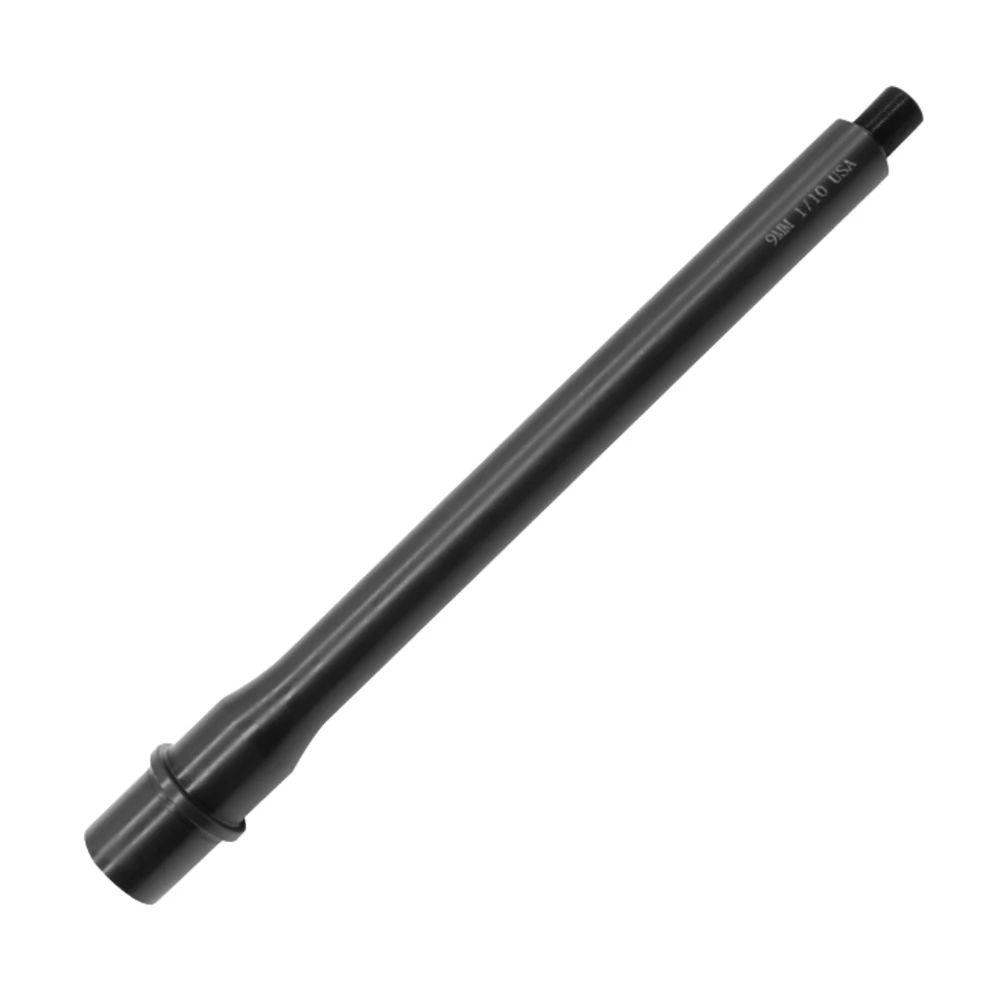
1:10. It’s the standard on nearly every 9mm AR barrel and stabilizes all common 9mm bullet weights. Some barrels use 1:16, and both work because 9mm bullets are short and easy to stabilize.
- 1:10 advantages: Handles 115-, 124- and 147-grain loads, including heavy subsonic 147s for suppressed shooting.
- 1:16 advantages: Slightly less spin on light, fast bullets.
- Disadvantages: Few in either case. For a 9mm AR, twist rate is rarely the problem, so put your attention on barrel quality, bolt and buffer instead.
For .45 ACP pistol-caliber carbines, 1:16 is the standard for 185- to 230-grain bullets.
Building an AR9? Browse our AR9 barrels or complete AR9 builds, then see our AR9 install guide.
AR22 Twist Rates (.22 LR)
What twist rate is best for .22 LR?
1:16 is the long-time standard and is plenty for 36- to 40-grain round-nose bullets.
- 1:16 advantages: Ideal for standard .22 LR ammo, with less leading from soft lead bullets.
- Faster twists (1:9 or 1:10): Only needed for heavy 60-grain subsonic .22 LR ammo.
Does twist rate matter with a .22 LR conversion kit?
Yes, and it’s the main reason conversion kits are less accurate. A conversion bolt fires .22 LR through your 5.56 barrel, which has a fast twist (1:7 to 1:9) designed for .224-inch jacketed bullets. Soft .22 LR bullets are slightly smaller, and a fast twist made for jacketed bullets tends to lead the bore. For real rimfire accuracy, run a dedicated .22 LR barrel with a 1:16 twist. For more on conversion and dedicated AR22 bolts, see our Bolt Carrier Group Guide.
Other Factors That Affect Twist Rate Performance
Does barrel length change the twist rate I need?
Barrel length doesn’t change the twist, but it does change velocity, and spin rate depends on both. A short barrel gives lower velocity and less spin, so heavy bullets in short barrels need more margin. That’s why short 300 Blackout barrels often go 1:7 or faster. Once you settle on a length, pick a handguard that fits your barrel length.
Does weather and altitude affect stability?
Yes. Cold, dense air at sea level is the hardest test for a bullet. A load that’s stable in warm weather or at high altitude can become marginal in winter at low elevation. That’s another reason to choose a twist with margin.
What is gain twist?
A gain-twist barrel starts with a slower twist near the chamber and speeds up toward the muzzle. It’s mostly found in specialty and competition barrels. For most AR builds, a standard constant twist is the way to go.
How to Find Your Barrel’s Twist Rate
Most barrels have the twist stamped near the muzzle or under the handguard, like “5.56 NATO 1:8.” If yours isn’t marked, measure it:
- Clear the rifle and remove the bolt carrier group.
- Push a cleaning rod with a tight patch a few inches into the bore. Use a rod with a rotating handle.
- Mark the rod at the top, and mark where it meets the receiver or muzzle.
- Push the rod until the top mark makes one full turn, then mark the rod again at the same reference point.
- Measure between the two marks. If it’s 8 inches, you have a 1:8 twist.
Quick Twist Rate Buying Checklist
- Identify the heaviest and longest bullet you plan to shoot, and buy for that.
- Choose a twist that keeps that bullet at or above an Sg of 1.5.
- When in doubt, go faster, not slower.
- For 300 Blackout or .458 SOCOM subsonics, go 1:7 or 1:14 respectively, or faster.
- Running copper or lead-free bullets? Check the ammo box for the minimum twist.
- Test new loads on paper, especially before mounting a suppressor.
Build the Right Barrel for Your Ammo
Twist rate comes down to one rule: match the barrel to the longest bullet you’ll shoot. For most AR-15s, that means 1:8. For a 300 Blackout running subs, it means 1:7. For a .308 AR-10, 1:10. For 6.5 Creedmoor, 1:8. For 9mm, 1:10, and for .22 LR, 1:16.
Pick the twist first, then browse our AR barrel collection to choose length, profile and gas system. Use our bolt carrier group guide to finish the upper, or start with one of our assembled upper receivers. Running suppressed or subsonic? Pair your barrel with an adjustable gas block to dial it in, and finish the muzzle with the right muzzle device.